
AMI
DensiPyc 1000
True Density Analyser
- (4–60°C) temperature-controlled pycnometer, precise density.
- Integrated microbalance enables accurate weighing.
- PC-controlled automation records data automatically.

Key Features
The AMI DensiPyc Series stands apart from traditional gas pycnometers by combining smart automation, flexible configurations, and precision features that enhance both productivity and data quality.
• Automated Sample Chamber Sealing
The DensiPyc uses an automated mechanical sealing system that applies consistent sealing force and positioning for every measurement. This eliminates variability introduced by manual tightening and improves repeatability across users and test runs.
• Intelligent Reference Volume Management
Multiple internal reference volumes are integrated into the system. During analysis, the software automatically selects the optimal reference configuration based on the installed sample cell, minimizing dead volume effects and improving volumetric accuracy across different sample sizes.
• Optional In-Situ Automatic Weighing (B Models)
Select models feature an integrated microbalance that allows samples to be weighed directly inside the instrument. This eliminates external weighing steps, reduces handling errors, improves traceability, and streamlines the workflow from loading through final reporting.
• Temperature-Control Options (TC models)
For samples that are temperature-sensitive, the TC (Temperature Control) models offer precise thermal regulation from 4°C to 60°C via an integrated Peltier module. This ensures consistent conditions and repeatable results, even for challenging materials.
• Vacuum Degassing Options (V models)
For materials that require pre-treatment prior to analysis, the V (Vacuum Degassing) models provide integrated vacuum conditioning to remove residual gases or moisture from the sample. The system supports vacuum levels down to 10 kPa, improving sample consistency and measurement repeatability, while maintaining a streamlined, single-instrument workflow.
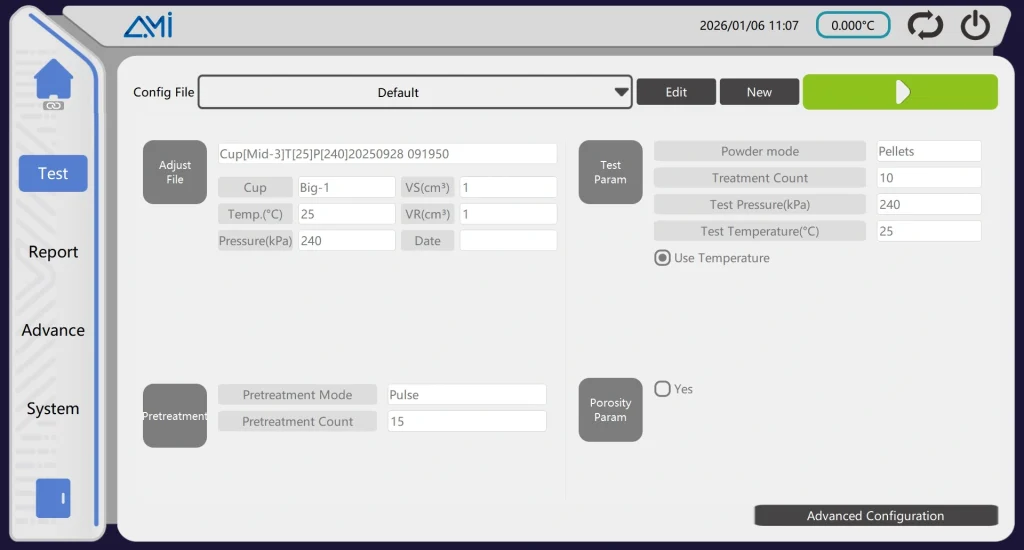
Software
Specifications
| Parameter | Specification |
|---|---|
| Test Gas | Helium, Nitrogen, Inert Gases |
| Gas Delivery Method | Pulsed injection or Flow with pressure equilibration, vacuum as option, Fine powder handling methods (Powder Guard Mode) |
| Repeatability |
|
| Accuracy |
|
| Sample Cell Volumes | 100 mL, 35 mL, and 10 mL (standard) Optional: smaller sample cups |
| Integrated Balance (model dependent) | Up to 500g; 0.001g balance resolution |
| Pressure Parameters |
|
| Data Output | PDF, TXT, Excel, connected via Ethernet |
| Temperature Range (model dependent) | 4–60°C (TC models only; Peltier-controlled); Stability: +/- 0.01°C; Accuracy: 0.002°C |
| Integrated Vacuum (model dependent) | Sample pretreatment via vacuum degassing (integrated pump) to 10kPa |
| Operating Environment | 15–35°C, 10–90% RH, non-condensing |
| Power | 100–240 VAC, 50/60 Hz, 120W (standard), 320W (temperature control) |
| Footprint (W × D × H) | 465 × 350 × 370 mm / 18 × 14 × 15 in |
| Weight | Approx. 10 kg / 22lbs |
| Applicable Standards | Measurements are performed using gas displacement principles in accordance with: ISO 12154; ASTM D4892, B923, C604, C830; DIN 66137; USP <699> |
| Sample Preparation Accessories (option) |
|