Bettersize
BeSEC
Molecular Weight Analyser
- Measure the absolute molecular weight
- Dual-angle light scattering detector
- Molecular weight range: 1 kDa to 2 GDa

Key Features and Benefits
Key Features
- Detection angles: 7° and 90°
- Molecular weight range: 1 kDa to 2 GDa
- Supports radius of gyration Rg > 12 nm
- Homopolymer and protein modes
- Acquires RI, UV, and start signals
- Intuitive software with real-time analysis
- 18 μL flow cell reduces band broadening
Benefits
- Proteins: Determine molecular weight, oligomer state, and aggregates
- Ppolymers and polysaccharides: Analyze molecular weight distribution and size
- No column calibration required since Mw is independent of elution volume
- Low-angle detection enables accurate molecular weight
- Compatible with any SEC or GPC system
Technical Specs
|
Technology
|
BeSEC LS1: 1 kDa to 20 MDa* BeSEC LS2: 1 kDa to 2 GDa* |
|
Rg
|
BeSEC LS1: N/A BeSEC LS2: > 12 nm* |
|
Detection Angle
|
BeSEC LS1: RALS (90°) BeSEC LS2: LALS (7°) and RALS (90°) |
|
Laser Source Type
|
Diode Laser |
|
Laser Power
|
10 mW |
|
Laser Wavelength
|
640 nm |
|
Sample Cell Volume
|
18 µL |
|
Acquisition Rate
|
5 Hz |
|
Dynamic Range
|
+/- 2500 mV |
|
Connection to PC
|
USB |
|
Measurement Modes
|
Homopolymer mode, protein mode |
|
Output Results
|
BeSEC LS1: Mn, Mw, Mz, Mp, Pd, dn/dc,
Concentration, Mw distribution |
|
Analog Outputs
|
RI, UV and start signals |
|
Solvent Compatibility
|
Aqueous and organic solvents |
|
Wetted Parts
|
PTFE, PEEK, glass, stainless steel |
|
Power Supply
|
AC 100-240 V, 50-60 Hz, 4.0 A |
|
Dimensions
|
450 × 325 × 157 mm (= 17.7″ × 12.8″ × 6.2″) |
|
Weight
|
11 kg (= 24.2 lbs) |
Technology
Determining Absolute Molecular Weight
with the Light Scattering Detector
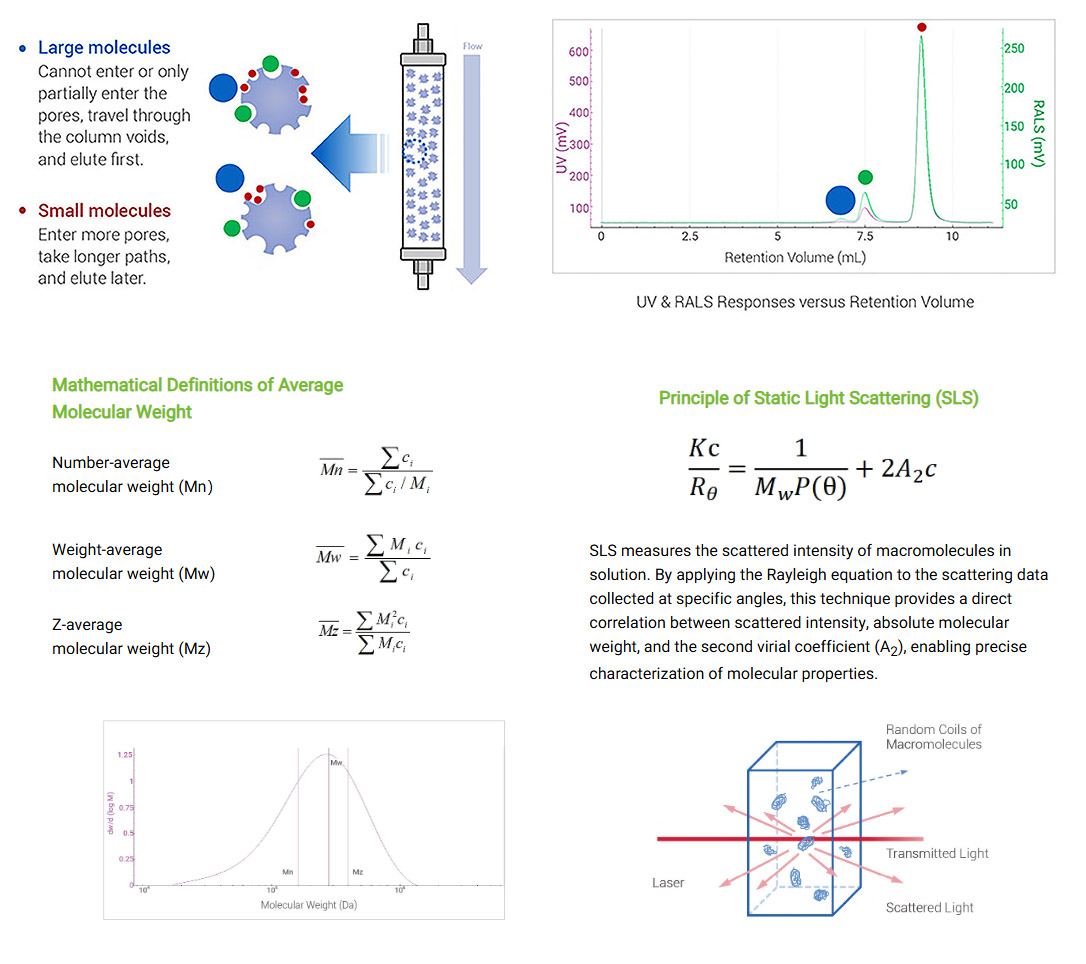
In size exclusion chromatography (SEC), separation depends only on the hydrodynamic size of the molecules. Larger molecules are unable to penetrate the pores of the stationary phase and elute earlier, while smaller molecules enter the pores and elute later. The separation mechanism is purely physical, and no chemical or adsorptive interactions occur between the solute and the stationary phase.
Breaking Free from Column Calibration
How the BeSEC Improves SEC/GPC Workflows
Traditional SEC/GPC systems without light scattering detection provide only relative molecular weight
These systems require calibration with a series of polymer standards to create a calibration curve of molecular weight versus retention volume.
Conventional methods that rely on retention volume introduce significant bias
Polymers with similar hydrodynamic size can elute at the same time yet differ greatly in molecular weight due to structural variations. Without light scattering detection, these differences remain hidden, making it impossible for traditional SEC or GPC to accurately distinguish between such samples.
Applications

Assess PET grade