
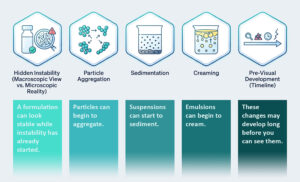
For formulation scientists, this creates a critical challenge:
How can you detect and measure instability before a formulation visibly fails?
Static Multiple Light Scattering (SMLS) offers a powerful approach to dispersion stability analysis.
Recent peer-reviewed research demonstrates how SMLS can monitor colloidal stability in real time. Research using the BeScan Lab+ also shows how the technique can help identify instability and support formulation optimisation.

Why visual inspection can miss formulation instability
Visual inspection remains a useful part of formulation development. However, it only tells you what you can see. A formulation may appear uniform even when particles have started to migrate, interact or aggregate. By the time sedimentation or phase separation becomes obvious, the underlying instability may already be well established. That creates a problem for formulation development. You may know that a formulation has failed. You may not know when the failure started or what caused it. Dispersion stability analysis can provide that missing information.
Why traditional stability testing may not tell the whole story
Many stability studies compare a formulation at different points in time. For example, you might measure a sample immediately after preparation and then repeat the measurement after storage. This approach can identify a change between two points. It does not necessarily show you the process that occurred between them. That distinction matters. Aggregation, sedimentation and phase separation can develop progressively. A formulation can therefore move from stable to unstable through a series of subtle changes. Continuous monitoring can capture those changes as they happen.
What is static multiple light scattering?
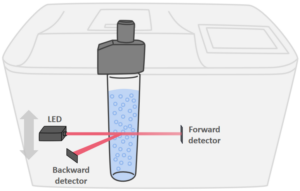
Static Multiple Light Scattering, or SMLS, measures changes in transmitted and backscattered light as light passes through a dispersion. As particles move, interact or change their physical state, they alter the way light travels through the sample. SMLS can detect these changes over time and across the height of the sample. This provides information about both the degree of instability and where it is occurring. That makes SMLS particularly useful for dispersion stability testing.
The BeScan Lab+ applies Static Multiple Light Scattering to dispersion stability analysis. The instrument scans through the sample and monitors changes in transmitted and backscattered light over time. This allows researchers to investigate physical changes throughout the sample rather than relying solely on a visual endpoint.
The system can detect changes associated with:
-
Sedimentation
-
Creaming
-
Flocculation
-
Coalescence
-
Phase separation
-
Particle migration
The BeScan Lab+ can also calculate an Instability Index, providing a quantitative way to compare formulation stability. That means researchers can move beyond a simple “stable” or “unstable” assessment. They can compare formulations and investigate how quickly each one destabilises.
Contact us for a demo or more information

Hit get in touch above